
Designing medical parts is stressful because patient safety is on the line. One tiny error in material choice or a hidden burr can cause a massive product recall or worse.
Medical device CNC machining uses high-precision computer-controlled tools to create complex parts from biocompatible materials. It ensures tight tolerances (down to ±0.005mm) and strict cleanliness standards required for implants, surgical instruments, and diagnostic equipment components that must interact safely with the human body.
I have spent over 20 years at Ranglink managing complex machining projects. I know that a drawing is just the beginning; the real challenge is making it manufacturable, clean, and compliant. I want to share my field experience to help you bridge the gap between a perfect 3D model¹ and a successful medical product.
What medical devices and parts are made using CNC machining?
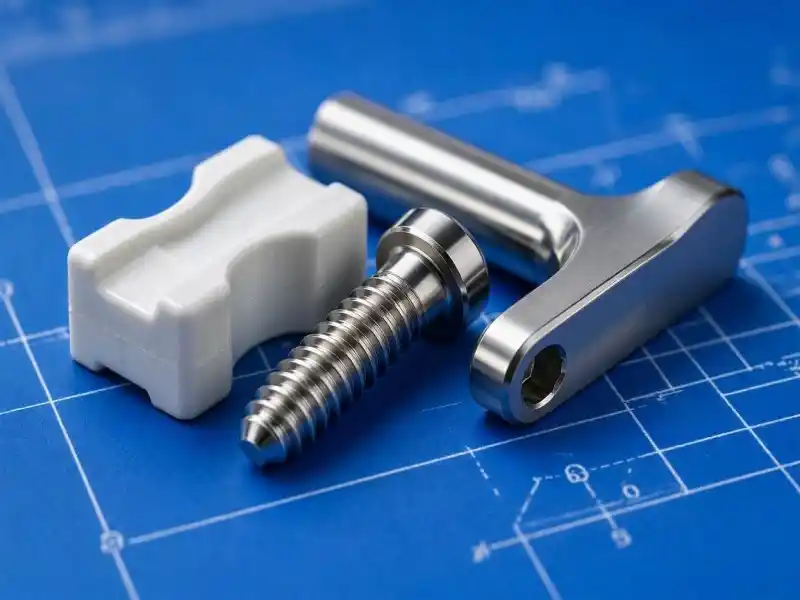
Medical parts fall into three distinct categories, and each one follows a completely different manufacturing logic depending on how it interacts with a patient.
CNC machining produces surgical instruments like bone forceps, implants such as bone screws and dental posts, and diagnostic equipment parts like analyzer pump bodies. Each category requires specific precision levels, biocompatibility, and sterilization protocols to ensure they function safely in medical environments.
Three Categories of Medical Parts
In my work at Ranglink, I always ask: “Does this part touch the human body or the machine?” Surgical instruments² like needle holders require high precision and the ability to survive repeated sterilization. Implants³, such as hip cups or dental implants, demand long-term biological stability. Equipment parts, like analyzer housings, focus more on cleanliness and dimensional consistency.
The Rise of Surgical Guides
Digital dentistry and orthopedics⁴ are booming. We now machine many custom surgical guides from medical-grade PEEK or PMMA based on patient CT scans. These guides need precise holes—we often hit ±0.02mm tolerances with internal surface finishes below Ra 0.4. Every guide must be individually cleaned and packaged because any tiny particle left behind is a risk.
Micro-Machining for Minimally Invasive Tools
Parts for endoscopes⁵ or laparoscopic tools are getting smaller while tolerances get tighter. I once handled a 3mm diameter titanium sleeve with a wall thickness of only 0.3mm. You cannot make these on standard machines; they require micro-tools and high-precision workholding. We use microscopes for final inspection to ensure the internal bores are 100% burr-free⁶.
| Part Type | Typical Materials | Key Requirement |
|---|---|---|
| Bone Screws/Plates | Ti-6Al-4V ELI | Biocompatibility & Strength |
| Surgical Guides | PEEK / PMMA | Precise Hole Alignment |
| Analyzer Pumps | Stainless Steel / PTFE | Chemical Resistance |
| Robotic Joints | Aluminum / Steel | Zero Backlash & Smooth Motion |
What are the best materials for medical CNC machining?
Choosing the wrong material in the medical field is a disaster, as some metals cause allergic reactions and some plastics crack during high-heat sterilization.
The best materials for medical CNC machining include Titanium (Ti-6Al-4V ELI) for implants, PEEK for bone-like flexibility, and 316LVM stainless steel for surgical tools. These materials are chosen for their biocompatibility, corrosion resistance, and ability to withstand rigorous medical sterilization processes without degrading.
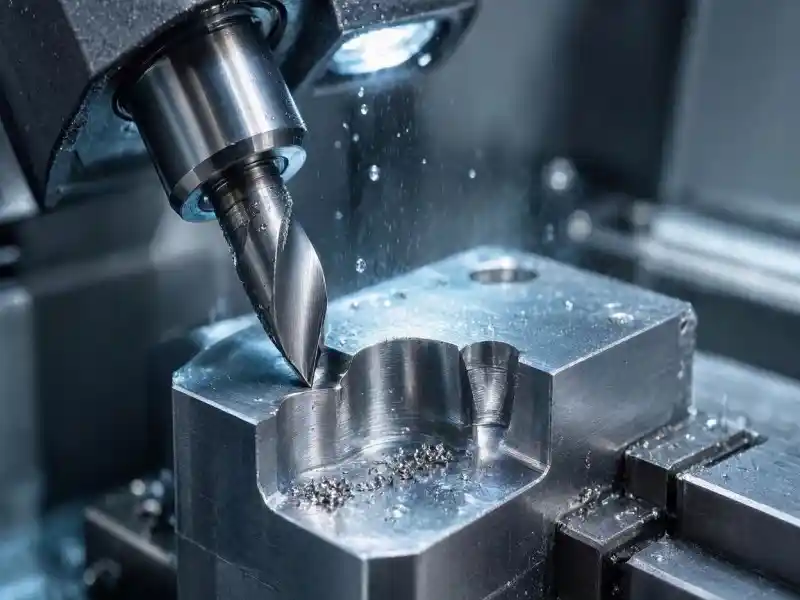
The Gold Standard: Titanium ELI
We use Ti-6Al-4V ELI⁷ for most implants. The “ELI” stands for Extra Low Interstitials, which provides better toughness than standard titanium. However, it is a nightmare to machine. It is gummy and wears down tools fast. At Ranglink, we run titanium at one-fifth the speed of aluminum and use high-pressure coolant to manage the heat.
PEEK: The Metal Alternative
PEEK⁸ is amazing because its flexibility is close to human bone, reducing stress shielding. But it is sensitive. We never use oil-based coolants on PEEK because it can cause stress cracking later. We only use compressed air for cooling and perform ultrasonic cleaning to ensure no chips are trapped in the material pores.
Medical Grade Stainless Steel
For surgical tools, 316LVM⁹ is the preferred choice over standard 316L. It is vacuum-melted for higher purity. It is very “sticky” during machining, so I always tell my team to use sharp carbide tools and maintain a steady feed rate to prevent work hardening¹⁰, which can ruin a part in seconds.
| Material | Best Use Case | Machining Challenge |
|---|---|---|
| Ti-6Al-4V ELI | Permanent Implants | High heat, fast tool wear |
| PEEK | Spinal Cages / Cranial | Sensitivity to chemicals |
| 316LVM | Surgical Instruments | Work hardening |
| Cobalt-Chrome | Joint Replacements | Extremely hard, requires grinding |
What tolerances, surface finishes, and cleanliness standards are required for medical CNC parts?
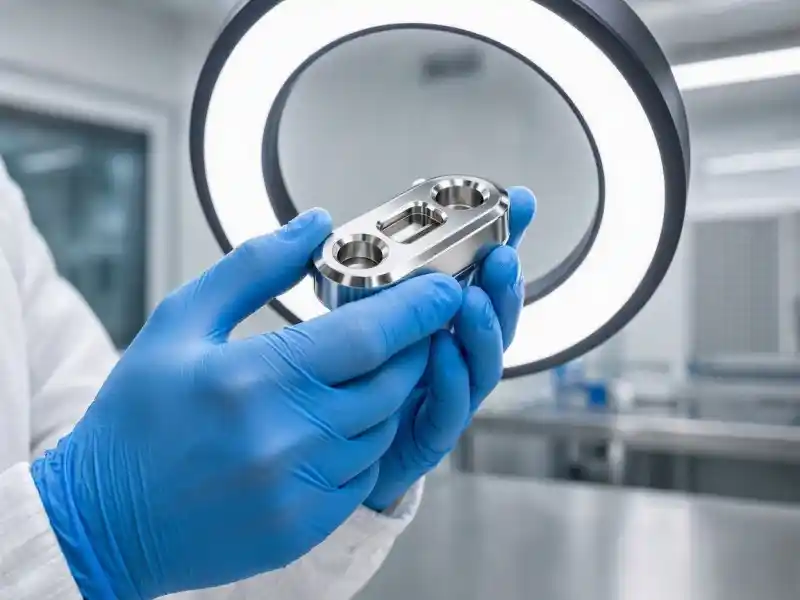
In the medical world, a dimension that is “close enough” does not exist; every micron and every microscopic scratch has a clinical consequence.
Medical CNC parts require three levels of tolerances: ±0.05mm for equipment, ±0.01mm for surgical tools, and ±0.005mm for high-precision implant interfaces. Surface finishes (Ra) range from 0.8 for screws to 0.05 for joints, and parts must be free of all oils, burrs, and particles.
The Cost of Tight Tolerances
I often see engineers mark every dimension as ±0.01mm. This makes the cost explode. In my experience, only the mating surfaces need that level of precision. At Ranglink, we help designers relax non-functional tolerances to ±0.1mm to save money, while focusing our high-end equipment on the critical ±0.005mm zones.
Surface Finish as a Function
A surface that is too rough can trap bacteria; a surface that is too smooth might prevent bone cells from attaching. Bone plates usually need Ra 0.4-0.8. If a part is for a sliding joint, we take it down to Ra 0.05. These numbers are not suggestions; they are requirements for the part to work inside a body.
The Invisible Gatekeeper: Cleanliness
A part can be dimensionally perfect but still be a “fail” if it has cutting fluid residue. Our medical workflow at Ranglink ends with ultrasonic cleaning¹¹, deionized water rinsing, and nitrogen drying. We then inspect under a magnifying glass. If your shop just “blows it off with an air gun,” it is not a medical shop.
| Requirement | Standard Range | Why it matters |
|---|---|---|
| Precision Tolerance | ±0.005mm to ±0.05mm | Proper fit and assembly |
| Surface Roughness | 0.05 Ra to 1.6 Ra | Bacterial control / Osseointegration¹² |
| Cleanliness | Zero residue | Prevents inflammation/infection |
| Sterilization | Autoclave¹³ / Gamma | Material must not turn brittle |
How to choose a compliant medical CNC machining supplier?
Selecting a supplier is the most critical decision an engineer makes because you are essentially choosing a partner to share your legal and technical risks.
To choose a compliant supplier, verify they have ISO 13485 certification, dedicated clean-room processing areas, and a robust material traceability system. A reliable partner should proactively provide DFM advice and prove their ability to handle medical-grade materials and specialized cleaning and packaging protocols.
Look Beyond ISO 9001
ISO 13485¹⁴ is the gold standard. It requires much stricter risk management and traceability than ISO 9001. At Ranglink, we hold ISO 9001 and focus on medical equipment parts that don’t touch the body. If a part requires ISO 13485, we are honest with the customer. Honesty is better than a failed audit.
Test Their Traceability
Ask a supplier: “How do you track material batches?” They must be able to show you the Material Test Report (MTR)¹⁵ and link it directly to the specific parts in your hand. If they cannot prove which “heat” of metal was used for your specific batch, your supply chain is at risk.
The Cleaning and Packaging Test
Medical parts cannot be thrown in a box with bubble wrap. Ask to see their cleaning process. A real medical supplier uses double-layered lint-free bags and vacuum sealing. I always suggest starting with a small trial order—maybe 5 or 10 pieces of a complex PEEK or Titanium part—to see if their actual quality matches their sales talk.
Conclusion
Success in medical CNC machining requires the right material, extreme precision, and absolute cleanliness. Choose a partner who understands these high stakes and communicates with total transparency.
Ready to start your next project?
Whether you need high-precision batch production or expert advice on the best machining path, I am here to help.
Contact me today for a fast quote:
Email: info@ranglink.com
WhatsApp: Message us on WhatsApp
- Overview of 3D modeling and digital design in engineering.
- Explanation of various surgical instruments and their uses.
- Information on medical implants and their application in the human body.
- Definition of orthopedics and medical treatments for the musculoskeletal system.
- Overview of endoscopy and minimally invasive diagnostic tools.
- Technical definition of burrs in machining and the importance of deburring.
- Properties and medical applications of the Titanium Ti-6Al-4V ELI alloy.
- Details on PEEK, a high-performance polymer used in medical implants.
- Information on surgical-grade stainless steels like 316L and 316LVM.
- Explanation of work hardening and its effect during metal cutting.
- Guide to ultrasonic cleaning processes used for precision parts.
- Scientific definition of osseointegration between bone and implants.
- Details on the autoclave sterilization process used in medicine.
- Information on the ISO 13485 quality management standard for medical devices.
- Explanation of Material Test Reports (MTR) for supply chain traceability.