
Are your CNC designs frequently rejected due to high costs? Selecting the wrong material often leads to manufacturing delays, broken tools, or unexpected part failure in the field.
To choose the right CNC material, you must evaluate mechanical stress, operating environment, and machinability. Balancing these factors ensures your part performs reliably while keeping production costs low. The best choice meets functional requirements without over-specifying properties that add unnecessary expense or manufacturing difficulty.
I have spent over 20 years on the shop floor at Ranglink. I see many talented engineers like Alex struggle when a beautiful 3D model¹ meets the reality of a CNC machine. Choosing a material is not just about picking a name from a handbook. It is about understanding how that material behaves under a cutting tool and how it survives in the real world. If we do not get this right at the start, we both lose time and money.
What Are the Core Mechanical and Environmental Requirements of Your CNC Part?
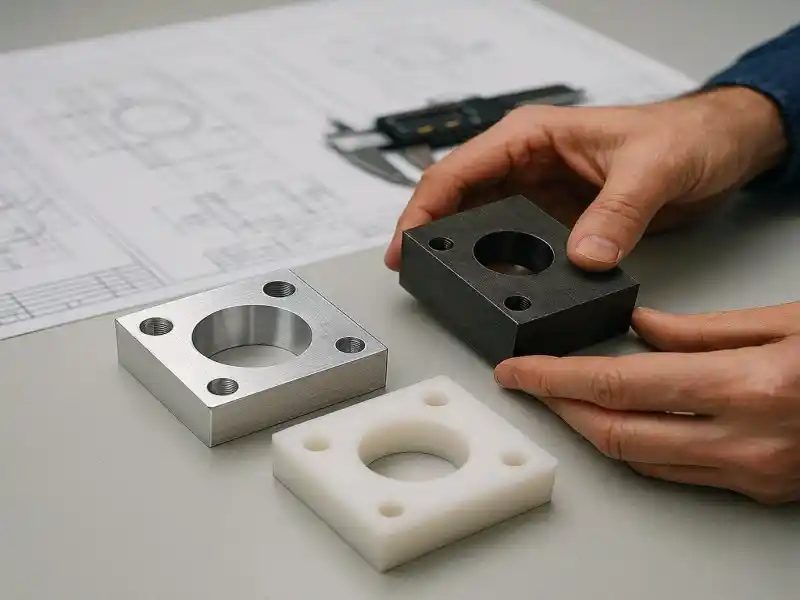
Do you find yourself choosing the strongest material just to be safe? This “safety” often leads to brittle parts that snap under impact or costs that spiral out of control.
Determine your part’s requirements by asking three questions: Where will it work, what chemicals will it touch, and what is the temperature? Focus on toughness over raw hardness to prevent sudden structural failure and match the material’s thermal expansion to your assembly’s working environment.
When I look at a drawing, I do not just see dimensions. I see a part that has to live in a specific environment. I always tell my clients to look beyond the grade number on the paper. For example, a customer once chose 6061 aluminum for outdoor brackets. Within six months, the salt air caused severe corrosion. If they had used 5052 aluminum or invested a few dollars in professional anodizing², they would have avoided a massive recall.
I also see a lot of “over-designing” when it comes to strength. High strength often means the material is brittle. I remember a gear design using high-carbon steel³ at HRC 60. It looked great on paper, but the teeth snapped the moment the machine started because it lacked toughness. We switched to 4140 quenched and tempered⁴ steel. The hardness dropped to HRC 35, but the toughness doubled. Those gears have been running for two years now without a single crack. You must match the material to the load type: is it steady pressure, a sudden impact, or constant vibration?
| Requirement Type | Key Consideration | Common Mistake | Ranglink Pro Tip |
|---|---|---|---|
| Environmental | Corrosion resistance | Using 6061 for salt/marine environments | Use 5052 or add Hard Anodizing |
| Mechanical | Toughness vs Hardness | Choosing “hardest” steel for impact loads | 4140 steel offers better impact fatigue |
| Thermal | Heat Deflection | Using POM (Delrin) above 80°C | Switch to PEEK or Aluminum for heat |
Finally, consider the temperature. If your part stays at room temperature, we can use annealed materials to save money. But if it works above 80°C, materials like POM start to soften and lose all precision. In those cases, you must use PEEK or an aluminum alloy to keep your tolerances tight.
Top CNC Machining Materials: Comparing Common Metals and Plastics?
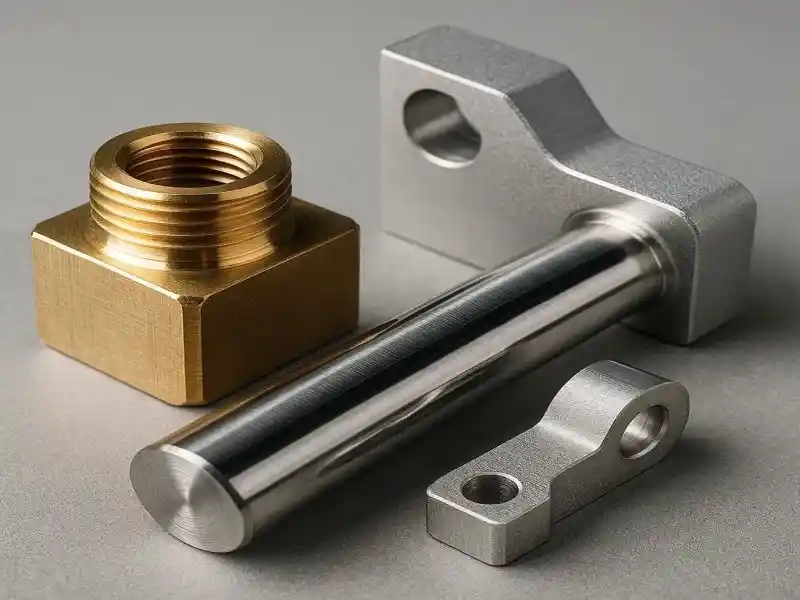
Are you confused by the endless list of alloys and polymers available today? Choosing a material that is difficult to cut can double your lead time and ruin your budget.
The most common CNC materials include 6061 Aluminum for general use, 303 Stainless Steel for easy machining, and Brass C360 for high precision. For plastics, POM is the standard for stability, while PEEK is reserved for extreme environments where high cost is justified by performance.
In my shop, I see how the “same” material can feel completely different. Take stainless steel, for example. Many engineers specify 304⁵, but if you do not need to weld the part, I always suggest 303. 303 has added sulfur. This makes the chips break cleanly, which extends our tool life by 30%. It is the difference between a smooth production run and a constant headache. The same applies to aluminum. 6061 is perfect for most structural parts. 7075 is much stronger, but it wears out our tools faster. Unless you absolutely need that extra strength for aerospace or high-stress parts, 6061 is your best friend for saving money.
I also believe Brass C360⁶ is the “forgotten king” of precision. If your design has tiny threads or very complex features and doesn’t carry a heavy load, use brass. It machines three times faster than steel, and we can easily hold a tolerance of ±0.01mm. The surface finish comes out like a mirror right off the machine. This is perfect for electronic connectors or valve bodies. On the plastic side, I often have to talk clients out of using PEEK⁷. PEEK is incredibly expensive and hard to process. If your application stays under 120°C, POM⁸ (Delrin) or PC will do the job for a fraction of the price.
| Material | Best For | Machinability | Cost |
|---|---|---|---|
| Aluminum 6061 | General structures | Excellent | Low |
| Stainless 303 | Precision/Non-weld | Good | Medium |
| Stainless 304 | Welding/Food grade | Poor | Medium |
| Brass C360 | Tiny threads/Valves | Superior | Moderate |
| PEEK | Extreme Heat/Chemicals | Difficult | Very High |
How Does Material Machinability Impact Your Overall CNC Production Costs?

Do you think the material price is the biggest part of your invoice? In reality, the time the part spends inside our CNC machines is what costs the most money.
Machinability dictates cost because it determines “material removal rates” and tool wear. “Free-machining” grades like 303 stainless or 12L14 steel allow for faster speeds and unattended operation. While the raw material might cost more, the reduction in labor and machine time significantly lowers the final price per part.
When I calculate a quote at Ranglink, I don’t look at the price per kilogram of metal. I look at how much metal I can cut away in one minute. This is the “unit time removal rate.” Titanium⁹ is a great example. The raw metal costs ten times more than aluminum. However, we have to cut it five times slower, and it eats through twenty times more cutting tools. By the time the part is finished, a titanium component might cost 30 times more than an identical aluminum one. You should always ask: “How long will it take to cut this?” instead of just “How much does the raw bar cost?”
Choosing “free-machining” grades is a secret way to save big on long production runs. A 303 stainless steel part might have a 5% higher material cost than 304, but the total cost is often 18% lower. Why? Because the chips break better, meaning I can let the machines run all night without a human watching them. We also spend less time changing broken drills or dull end mills.
| Factor | Low Machinability (e.g., Titanium) | High Machinability (e.g., Brass/6061) |
|---|---|---|
| Cutting Speed | Very Slow | Very Fast |
| Tool Cost | Frequent replacements | Long-lasting tools |
| Labor Cost | High (constant monitoring) | Low (unattended running) |
| Surface Finish | Hard to control | Easy to achieve |
Don’t forget the “hidden” costs of heat treatment¹⁰. If you mark a drawing “Harden to HRC 50,” the part will likely warp during the heat process. This means I have to leave extra material and then use a precision grinder to reach the final size. Grinding¹¹ is much more expensive than milling. If you can use a “pre-hardened” steel like P20 or NAK80, we can machine it directly to the final size. You get a hard part and skip the extra steps, saving a lot of money in the process.
Conclusion
Choose materials based on real-world environment and machinability. Focus on “free-machining” grades and avoid over-specifying hardness to reduce costs and ensure your CNC project’s success with Ranglink.
Ready to start your next project?
Whether you need high-precision batch production or expert advice on the best machining path, I am here to help.
Contact me today for a fast quote:
Email: info@ranglink.com
WhatsApp: Message us on WhatsApp
- Overview of 3D computer graphics and modeling processes.
- Technical explanation of the anodizing surface treatment process.
- Metallurgical properties and applications of high-carbon steel.
- Guide to the quenching and tempering heat treatment process.
- Material data and specifications for 304 stainless steel.
- Information on the properties and machinability of brass alloys.
- Characteristics and engineering uses of PEEK polymer.
- Properties and industrial applications of POM (Delrin) plastic.
- Information on titanium’s physical properties and machining behavior.
- Overview of industrial heat treatment methods for metals.
- Explanation of grinding operations for high-precision material removal.