
Your automated production line stops because a simple gripper¹ failed. Designing a perfect robot is useless if the custom robotic end-effector parts at the end cannot hold a part accurately or reliably.
Precision end-effector parts are the only link between a standard robot and your specific product. If tolerances are off by even 0.05mm, the robot’s overall positioning accuracy falls outside the acceptable range, leading to dropped parts, air leaks, and expensive downtime in high-speed automation environments.
I have seen many engineers focus on the robot’s brand while ignoring the quality of the custom fingers and brackets. This mistake usually leads to a painful realization during the final site acceptance test. You need a partner who understands that a gripper is not just a block of metal, but a high-precision instrument.
Why are end effectors important in robotics?
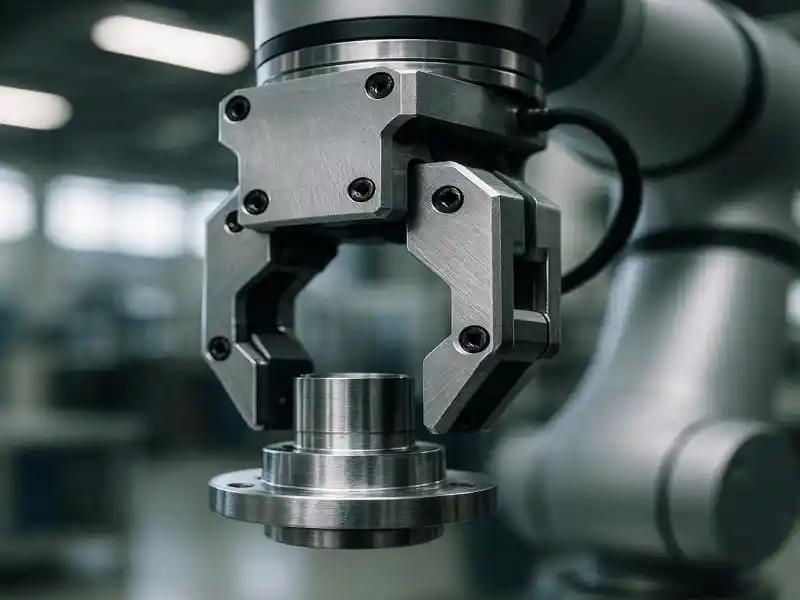
A robot arm is a standard product, but the end effector is a custom solution. You can buy a high-end Fanuc² or ABB³ robot easily, but it cannot perform tasks without the specific gripper or suction base we build for it.
The end effector is the only part of the robot that actually touches your product. No matter how accurate the robot arm is, a 0.1mm deviation in the gripper means the part will not fit into the assembly, causing the entire system to fail.
The Bridge Between Motion and Results
In my daily work at Ranglink, I often see customers spend a fortune on a six-axis robot⁴ only to struggle with a poorly machined fixture. Think of it like a world-class archer using a crooked arrow. The robot provides the speed and the path, but the end effector provides the final touch. If the mounting holes are slightly off or the fingers are not perfectly centered, the robot’s precision is wasted. I always tell my clients to check the fixture parts for deformation or misalignment before they start debugging the robot software.
The Cost of a Weak Grip
Losing a grip is worse than not gripping at all. I once worked on a project for a PCB⁵ handling tool. The customer’s previous supplier made vacuum suction holes with inconsistent depths. Some holes leaked air, and the boards dropped inside the machine during high-speed movement. This caused the whole line to stop for hours. It wasn’t a robot error; it was a machining quality issue.
| Component Type | Role in Precision | Common Failure Point |
|---|---|---|
| Robot Body | Provides repeatable motion | Software or motor limits |
| Mounting Plate | Connects tool to robot | Flatness and hole alignment |
| Custom Fingers | Direct contact with part | Wear and dimensional drift |
What are the limitations of end effectors?
Designing end effectors requires a difficult balance between keeping the tool lightweight and ensuring it is stiff enough. If the tool is too heavy, the robot slows down; if it is too weak, the parts fly out.
End effectors are limited by the robot’s payload capacity and the raw material’s physical properties. They must also compensate for the tolerances of the incoming workpieces, which are often less precise than the gripper itself.
The Conflict of Weight and Rigidity
Every gram matters at the end of a robot arm because it affects the maximum acceleration. Designers try to make aluminum parts as thin as possible. However, if an aluminum finger is too thin, it will flex when it clamps a part. I often suggest adding a 1mm rib to critical stress areas. This adds less than 5% to the weight but can double the stiffness. It is a simple change that prevents parts from vibrating or falling out during fast moves.
Environmental and Material Constraints
Environment is a huge limitation that engineers sometimes forget. If you use 6061 aluminum⁶ grippers for hot castings coming out of a furnace, the heat will soften the metal at 150°C. I saw a customer’s tool deform and fail in two weeks because of this. Switching to 4140 steel⁷ solved it. Similarly, in a cleanroom⁸, you cannot use oily anti-rust treatments; you need stainless steel or Teflon⁹ coatings. You must also consider that if your raw workpiece is a rough casting with 0.5mm fluctuations, even a perfect ±0.01mm gripper will struggle unless you design floating structures or manual adjustment margins.
How do poor tolerances cause end-effector failure?
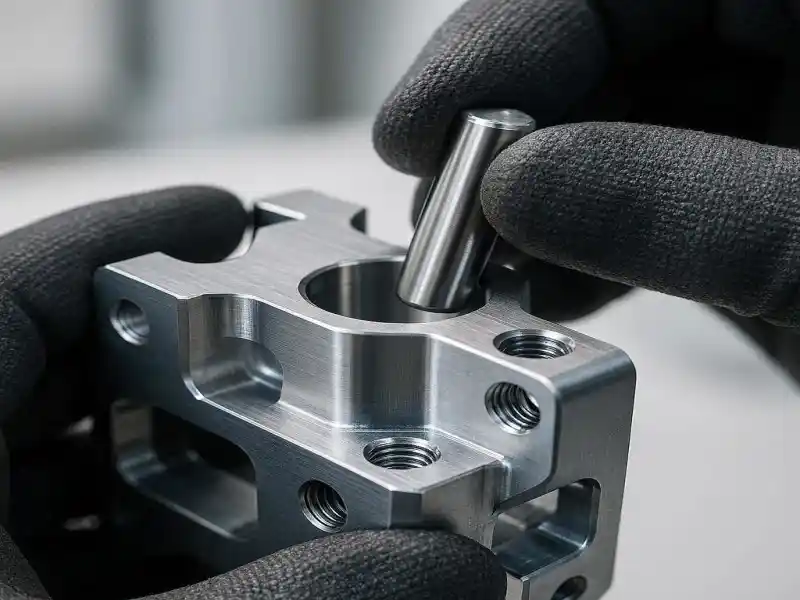
Small errors in the machining shop become massive problems on the factory floor. Because a robot has multiple joints, a tiny misalignment at the base of the gripper is amplified across the entire length of the system.
Poor tolerances lead to “tolerance stacking,” where small errors add up to a failure. This causes excessive vibration, air leaks in pneumatic systems, and rapid wear of dowel pins, turning a precise machine into a loose, shaking mess.
The Amplification Effect
Robotics is about geometry. A tiny angular error at the mounting flange might seem small, but at the end of a 2-meter robot arm, that error is magnified. Suddenly, the robot cannot line up a screw with a threaded hole. I have seen this happen many times. Because six-axis robots have slight play in every joint, the machining error of the fixture base is the “final straw” that breaks the precision of the entire cell.
Short Life Spans from “Good Enough”
I once saw a gripper where the pin holes had a clearance of ±0.05mm. The designer thought it was close enough. But in high-speed operations, this tiny gap turned into a heavy impact every time the gripper opened and closed. After three months of thousands of cycles a day, the round holes became oval. We replaced them with parts reamed¹⁰ to H7 tolerances. By controlling the fit clearance to just a few microns, that same fixture lasted over a year without needing new pins. “Looking the same” is not “measuring the same.”
| Tolerance Issue | Immediate Symptom | Long-term Impact |
|---|---|---|
| Poor Parallelism | Part tilting or jamming | Premature bearing wear |
| Loose Pin Fits | Visible vibration | Ovalized holes and failure |
| Surface Roughness | Air leaks in seals | Frequent seal replacement |
How to select a machining partner for high-precision end-effector parts?
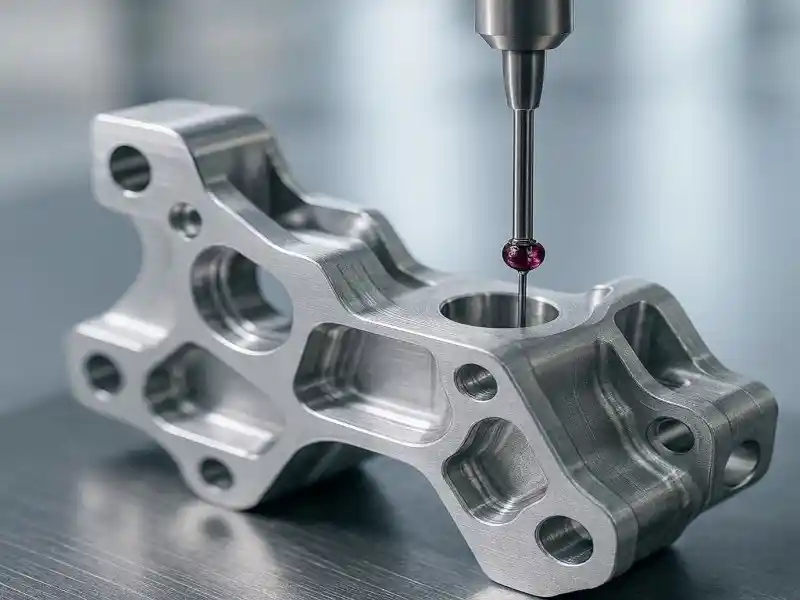
Choosing the wrong shop will lead to repeated design revisions and delays. You need more than just a vendor; you need a partner who acts like an extension of your own engineering team.
A reliable partner must provide CMM inspection reports, demonstrate deep knowledge of DFM for automation, and offer expert advice on material selection. If a shop cannot prove their tolerances with data, they are just guessing with your project.
Demand Data and Real Experience
The first rule is to ask for a measurement report. Many shops claim they can hit ±0.01mm, but they don’t have a CMM (Coordinate Measuring Machine)¹¹ to prove it. At Ranglink, we provide dimension reports for every critical automation part. It is the only way to be sure the part matches the drawing. Secondly, check if they actually understand automation. A shop that doesn’t ask you DFM¹² questions—like whether a hole can be a through-hole for easier chip removal—isn’t thinking about your final assembly. They are just cutting metal without understanding the function.
Material and Process Guidance
A good partner helps you choose the right materials. If a design is for a high-speed gripper, I might suggest 7075 aluminum¹³ instead of 6061, or even 4140 alloy steel for high-load fingers. You shouldn’t have to guess based on a handbook. We have over 20 years of experience and 100 machine tools to back up our suggestions. When you find a partner who proactively points out risks and offers solutions to lower costs or increase part life, you have found the right team to help turn your complex blueprints into reality.
Conclusion
Precision in end-effector machining is the foundation of successful automation. By focusing on tight tolerances and expert material selection, you avoid the hidden costs of failure and system downtime.
Ready to start your next project?
Whether you need high-precision batch production or expert advice on the best machining path, I am here to help.
Contact me today for a fast quote:
Email: info@ranglink.com
WhatsApp: Message us on WhatsApp
- Overview of robotic end effectors and their applications in automation.
- Information about FANUC, a leading industrial robotics manufacturer.
- Background on ABB, a major multinational robotics and automation corporation.
- Technical explanation of six-axis and articulated robotic arms.
- Definition and manufacturing processes of Printed Circuit Boards (PCBs).
- Material properties and common uses of 6061 aluminium alloy.
- Information on alloy steels including 4140 used for high-stress applications.
- Standards and environmental controls used in manufacturing cleanrooms.
- Scientific details on PTFE (Teflon) and its low-friction, non-reactive properties.
- Explanation of the reaming process used to achieve highly precise hole tolerances.
- Overview of Coordinate Measuring Machines (CMM) for precise dimensional inspection.
- Guide to Design for Manufacturability (DFM) principles in engineering.
- Technical data on 7075 aluminium alloy known for its exceptional strength.