
Many buyers wonder why precision varies between factories. I used to think the machines themselves were the issue, until I learned that true precision begins with understanding the entire CNC machining process.
The CNC machining process is a digital-to-physical manufacturing workflow where a 3D design is converted into a precise product through computer-controlled machines such as mills, lathes, and routers.
Once I understood this chain clearly, project costs dropped, lead times shortened, and customers started trusting our repeat accuracy. Knowing how it works gives any manager or engineer a clearer picture of what really drives machining results.
CNC machining is much more than pressing a button. It’s about planning, programming, setup, execution, and checking every millimeter. Let’s break these steps down to see exactly how parts come alive.
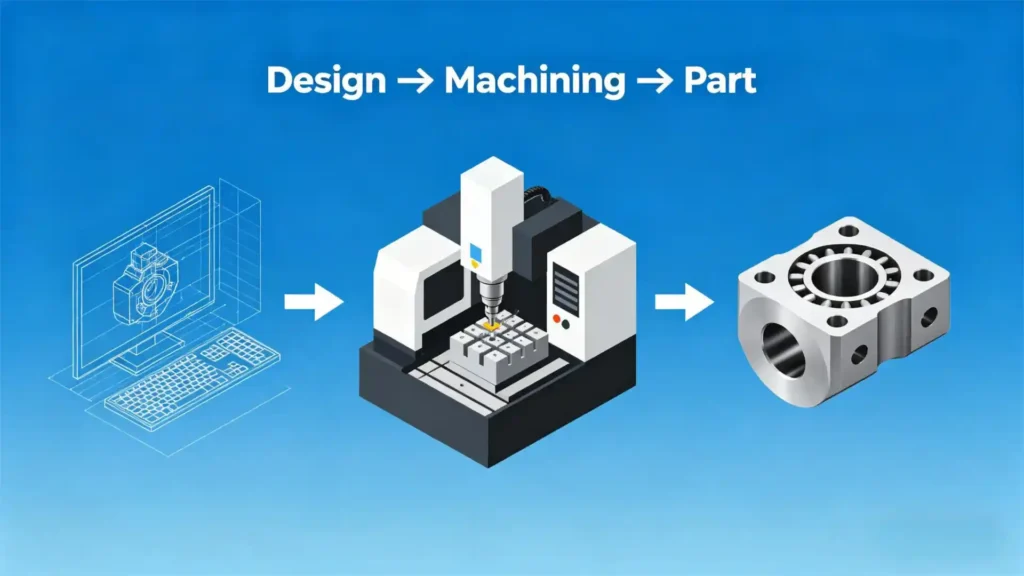
What is a CNC procedure?
Many newcomers assume CNC machines handle everything automatically. But that belief leads to wasted time and money. When I first managed a production order without understanding the full procedure, alignment errors piled up. Only later did I realize the CNC process requires detailed preparation before cutting starts.
A CNC procedure is the organized series of steps used to turn a 3D design[1] into a finished part, including design creation, coding, setup, machining, inspection, and finishing.
Knowing each stage helps balance responsibility between designer, programmer, and technician. Here’s how the entire procedure unfolds step by step.
Step-by-step process overview
| Stage | Description | Tools or Equipment |
|---|---|---|
| 1. Design | Create a 3D or 2D model according to part requirements | CAD software[2] |
| 2. Programming | Convert the model into machine-readable G-code instructions[3] | CAM software[4] |
| 3. Setup | Secure material and install proper tools | Fixtures, cutting tools, CNC machine |
| 4. Machining | Execute programmed cuts, drilling, and contouring | CNC milling machines[5], lathes |
| 5. Inspection | Check dimensions and tolerances | CMM, calipers, gauges |
| 6. Finishing | Apply surface treatments like polishing or coating | Abrasive wheels, sanders, plating tools |
Each step ensures predictable and consistent output. When I refined how we handled tool setup and positioning, the defect rate on aluminum housings fell by nearly half. The procedure is not simply mechanical; it is a routine of discipline that keeps every part identical from batch to batch.
How does CNC machining work?
When I first watched a CNC machine moving, I saw it glide in silent precision. Every line in the program became a motion path. Still, I was puzzled about how exactly it followed each number and direction so accurately. Once I grasped that concept, every production decision became clearer.
CNC machining works by interpreting digital commands (G-code) that guide a machine’s motors to move tools along controlled paths, removing material precisely until the part matches the programmed design.
The “computer numerical control” system coordinates motion in all directions at high speed. Below is a simple breakdown of how the core components work together.
Inside the machining process
| Component | Function | Example in Practice |
|---|---|---|
| Computer | Processes input design data | Reads CAD/CAM files |
| Controller | Converts data into movement instructions | Sends commands to machine motors |
| Actuators | Move the cutting tools and workpiece | Controls X, Y, Z axes |
| Tools | Remove chosen materials | End mills, drills, cutters |
| Feedback system | Monitors and corrects position | Sensors, encoders, tracking systems |
When one axis moves even a hair off its target, the feedback system sends signals to correct it instantly. That’s how a CNC machine maintains tight tolerances. I learned that the best results appear when the software and mechanics work in perfect sync. Even small lags cause chatter or surface defects.
This understanding changed how I scheduled jobs. Instead of expecting every machine to produce at full speed, I started matching programs with each machine’s control limits. Production became more stable, surfaces smoother, and tool wear much lower.
What skills do you need for CNC machining?
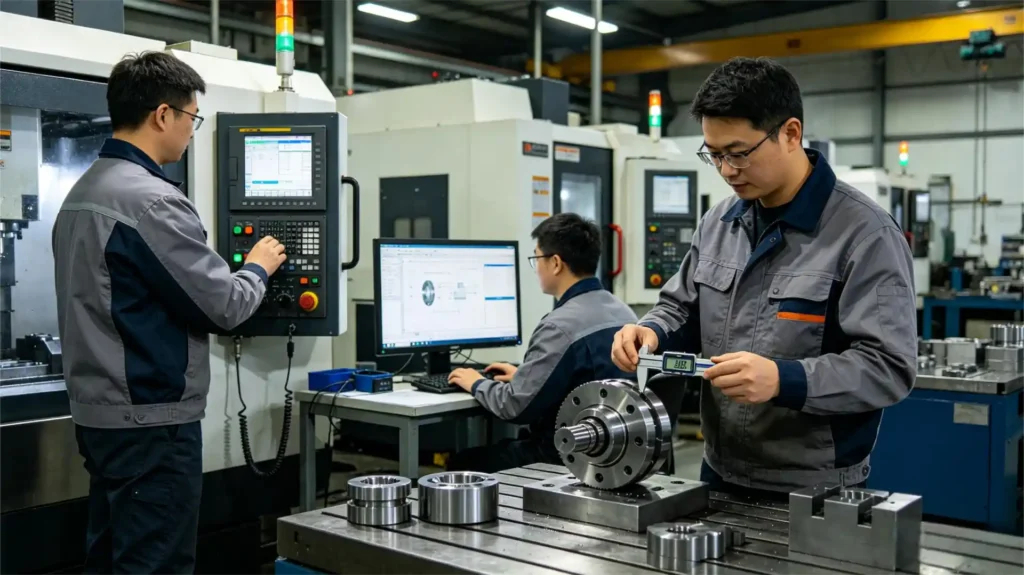
Even the most advanced CNC machine can’t create perfect parts without skilled hands behind it. I’ve seen operators misuse flawless systems simply because they missed basic fundamentals in setup and coding. Technology performs, but skill guides it.
CNC machining requires practical knowledge in technical drawing[6], G-code programming, tooling setup, measurement, and troubleshooting to maintain precision and efficiency[7] from start to finish.
Let’s look at what these skills mean in daily work.
Key skill areas
| Skill Type | Description | Why It Matters |
|---|---|---|
| Technical understanding | Read and interpret blueprints and tolerances | Guarantees the design is built correctly |
| Programming knowledge | Write or modify G-code instructions[3] | Prevents tool collisions and shape errors |
| Machine setup | Adjust fixtures, install correct tools | Maintains accuracy and reduces vibration |
| Measurement and inspection | Use calipers, micrometers, CMM tools[8] | Confirms precision after machining |
| Troubleshooting ability | Identify and fix machining or program issues | Reduces downtime and waste |
One technician I trained years ago improved our output simply by learning programming basics. He caught a wrong feed rate in a prototype job—something software wouldn’t warn about. Once corrected, the same part finished twice as fast and met all surface requirements.
CNC machining is a combination of theory and repetition. Skills grow only through practice. I often tell new machinists that knowing how to measure properly is just as valuable as running the machine. Measurement closes the feedback loop, turning code into reality. Each skill connects like gear teeth—if one slips, production slows.
Why understanding the CNC process matters?
Before I understood the details, I often rushed price negotiations without considering process time or tool change complexity. That led to wrong expectations and harder supplier relationships. Once I learned how processes actually work, conversations changed from cost debates to technical collaboration.
Understanding the CNC process helps buyers and engineers estimate production time, assess costs accurately, and set realistic quality expectations with partners or suppliers.
How process knowledge improves decision-making
| Factor | Impact of Understanding | Example |
|---|---|---|
| Design feasibility | Avoids impossible geometry or tight tolerances | Adjusts radii for cutting tool limits |
| Quotation accuracy | Improves cost prediction | Faster, fairer RFQ evaluation |
| Quality control | Predicts inspection needs | Plans tolerance testing earlier |
| Relationship building | Creates clear communication with suppliers | Aligns specs without repeated revisions |
When I helped one overseas client analyze their design before quoting, they realized a simple chamfer adjustment reduced machining time by 30%. Understanding process logic creates mutual trust. It bridges the gap between design intent and factory delivery, ensuring smooth collaboration.
Conclusion
CNC machining turns digital designs into precise, repeatable parts through careful planning, coding, setup, and inspection. Understanding this process and developing proper skills ensures accuracy, efficiency, and long-term reliability across every production order.
Ranglink offers precision CNC machining – from prototypes to production. Get a competitive quote within 24 hours. Contact us today.
- Email: rang@ranglink.com
- Website: www.ranglink.com
- WhatsApp: +86 17338532394
[1]: Learn about the importance of 3D design in CNC machining and how it impacts the final product.
[2]: Find out how CAD software plays a vital role in creating designs for CNC machining.
[3]: Discover how G-code instructions guide CNC machines and ensure precision in manufacturing.
[4]: Explore the relationship between CAM software and CNC machining for efficient production.
[5]: Learn about CNC milling machines and their significance in the machining process.
[6]: Understanding technical drawing is essential for accurate CNC machining and production.
[7]: Learn about the key factors that enhance precision and efficiency in CNC machining.
[8]: Discover the role of CMM tools in ensuring precision and quality in CNC machining.