
Is your plastic design failing during manufacturing or cracking shortly after delivery? Selecting the right plastic and the right machining partner can determine whether your product succeeds or becomes a pile of scrap.
CNC plastic machining uses high-speed cutting tools to remove material from solid plastic blocks. It offers tighter tolerances than 3D printing and better material properties than injection molding for small batches. Choosing the right polymer depends on your specific application, budget, and structural requirements.
I have seen many engineers struggle with plastic parts that warp, crack, or change size overnight. Transitioning from metal to plastic design requires a mindset shift because polymers¹ behave very differently under heat and pressure.
What plastics are best for CNC machining?
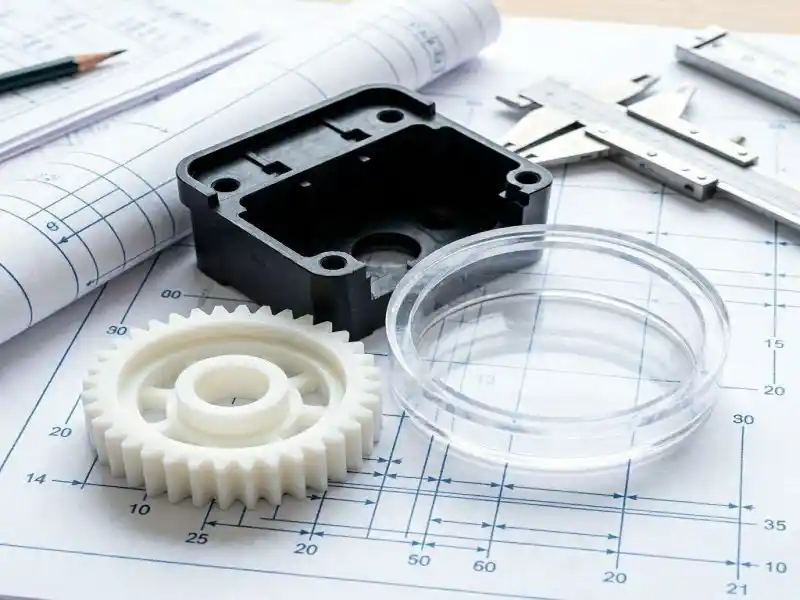
Are you looking for a material that machines like a dream and holds its shape perfectly? While many plastics are available, a few stand out as the most reliable choices for high-precision components in a CNC shop.
POM, also known as Delrin, is the undisputed king of CNC plastics due to its excellent dimensional stability and smooth chip formation. Other top choices include PC for transparency, ABS for versatility, and Nylon for wear resistance, provided you account for their specific environmental sensitivities.
In my 20 years at Ranglink, I have found that POM² is our favorite to machine. The chips come off like fine sand, and the parts remain incredibly stable. However, I always warn my clients: do not use POM if you plan to glue parts together later. Its surface energy is so low that most adhesives³ simply won’t stick. If your design requires bonding, I will suggest moving to PC or ABS instead.
Nylon⁴ is another popular choice, but it has a “breathing” problem. I remember a batch of nylon gears we made that were perfect in our shop. After they arrived at a client’s facility in a humid region, the holes shrank by 0.05mm because the material absorbed moisture. Now, we let all nylon parts sit in a temperature-controlled room for 48 hours before final inspection.
For clear parts, Acrylic and PC are the standards, but they require different handling. Acrylic⁵ is beautiful but brittle like glass. If you put too much torque on a screw in an acrylic block, it will crack instantly. PC⁶ is much tougher, but it hates certain coolants. If we use a coolant with aromatic hydrocarbons on PC, the part will develop tiny “spider web” cracks the next day. At Ranglink, we only use water-soluble coolants or compressed air for PC to keep your parts crystal clear and strong.
| Material | Key Advantage | Best Application | Main Limitation |
|---|---|---|---|
| POM (Delrin) | High stability | Gears, Bearings | Difficult to bond/glue |
| PC | Impact resistance | Transparent covers | Sensitive to chemicals |
| ABS⁷ | All-rounder | Enclosures, Prototypes | Low heat resistance |
| Nylon | Low friction | Wear strips, Bushings | Absorbs moisture |
| Acrylic | Optical clarity | Display panels | Brittle, easy to chip |
What are the common mistakes when cutting plastic?
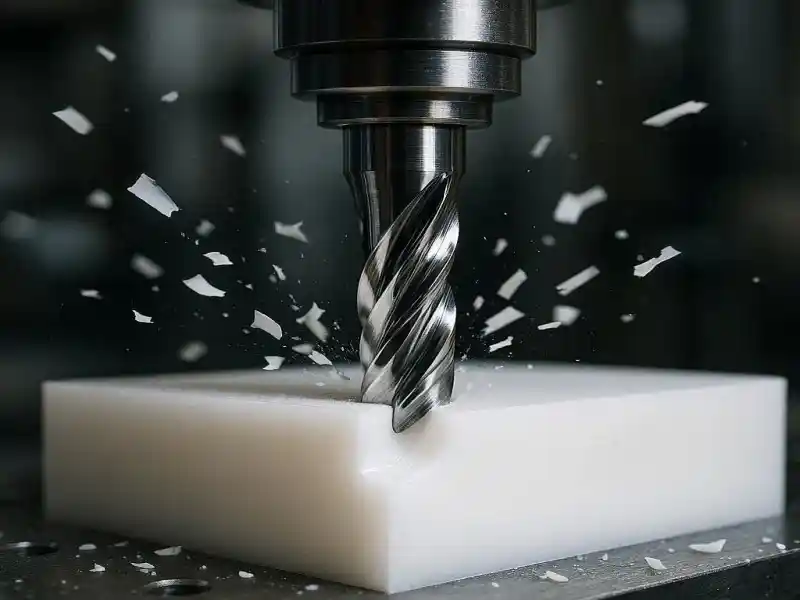
Why do your plastic parts often come back warped or with a poor surface finish compared to metal parts? Many shops treat plastic like soft metal, but that is a fundamental error that leads to expensive rework.
The most common mistakes include using excessive clamping force, using dull tools previously used on metal, and failing to manage heat. Because plastics have high thermal expansion and low melting points, improper machining parameters will cause deformation, melting, or internal stresses.
The silliest mistake I see is clamping the workpiece too tight. Plastics are much more flexible than steel. If you tighten a vise on an Acrylic plate like you would on a block of steel, the material compresses. Once the machining is done and you release the vise, the part springs back, and every hole location is suddenly out of tolerance. At Ranglink, we rough-machine with a margin to release internal stress⁸, then use a very light touch for the final pass.
Using “second-hand” tools is another trap. Some shops think that because plastic is soft, any old tool will work. That is wrong. If you use a dull cutter that just finished a run of stainless steel on a piece of plastic, the surface will look like sandpaper. We maintain a dedicated set of mirror-polished carbide end mills⁹ specifically for plastics. These tools never touch metal, ensuring the sharpest possible cut.
Heat is the ultimate enemy here. When you cut metal, you worry about the tool getting soft; with plastic, we worry about the material melting. If the spindle speed is too high, friction creates heat and the plastic sticks to the tool. If the feed rate¹⁰ is too slow, the tool rubs the same spot for too long. We use a “low speed, fast feed” strategy to get the heat out with the chips. Finally, small threads are a nightmare in plastic. I always tell my clients to use threaded inserts or larger thread sizes, as M2 threads in plastic will strip after just a few uses.
What is a cheap but strong plastic?
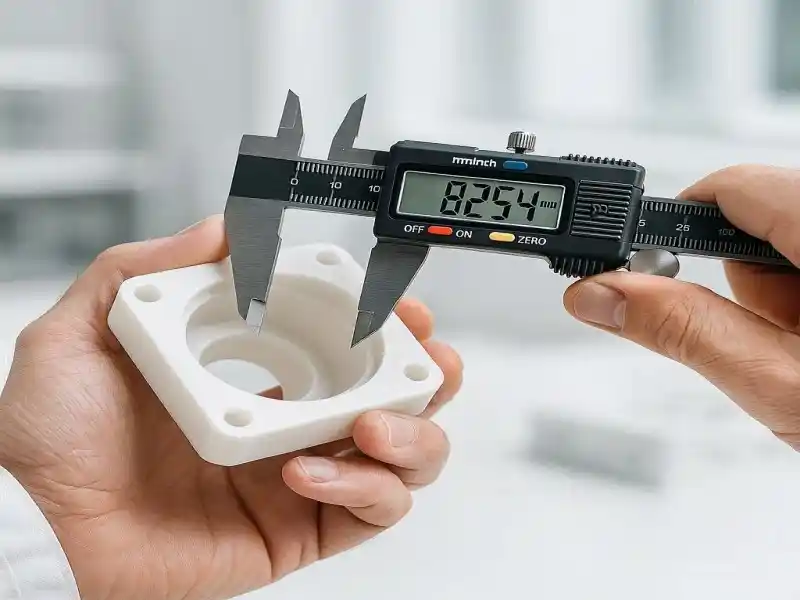
Do you need high performance without the high price tag of aerospace-grade polymers? Many engineers default to expensive materials like PEEK when a much more affordable option would do the job just as well.
ABS is the best value-for-money plastic for general use, offering a great balance of strength and cost. For structural parts, Glass-Filled Nylon provides high rigidity at a fraction of the cost of high-end polymers, while POM serves as a budget-friendly alternative to PEEK for many applications.
I always recommend ABS as the “standard” choice. If your part doesn’t need to survive high heat or harsh chemicals, ABS is usually the winner. It is cheaper than POM, tougher than Acrylic, and produces a great surface finish. About 80% of the electronic housings and consumer product prototypes we make at Ranglink are ABS. It is the king of cost-effectiveness.
Sometimes clients come to me asking for PEEK¹¹ because they need heat resistance. When I ask for their actual working temperature, it is often only around 100°C. In those cases, I suggest POM. POM can handle those temperatures easily, yet the material cost is about one-tenth of PEEK. Unless you are going over 120°C, don’t waste your budget on PEEK.
If you need real structural “muscle,” Glass-Filled Nylon (like PA6+GF30) is a great “hard” material. By adding 30% glass fiber¹², the stiffness and heat resistance jump up significantly, but the price stays much lower than exotic plastics. You should know that glass fibers are hard on tools, so the machining cost is a bit higher, but the material savings are huge. Lastly, don’t overlook PP¹³ (Polypropylene) for living hinges. It is incredibly cheap and can be bent thousands of times without breaking, making it better than ABS for clips and tabs.
| Material | Relative Cost | Strength Level | Key “Cheap” Feature |
|---|---|---|---|
| ABS | Low | Medium | Best for prototypes |
| POM | Medium | High | “Poor man’s PEEK” |
| GF-Nylon | Medium-High | Very High | High rigidity/price ratio |
| PP | Very Low | Low-Medium | Excellent fatigue life |
Which plastics should you avoid?
Are there any plastics that a CNC shop will refuse to handle? While we like to say we can machine anything, certain materials pose risks to our machines and our technicians that are simply not worth the trouble.
You should generally avoid CNC machining PVC and certain highly flexible elastomers. PVC releases toxic, corrosive gases when heated, which can damage machine components and harm operators. Soft materials like TPU are often better suited for 3D printing or molding rather than traditional milling.
At Ranglink, I have a strict rule: No PVC¹⁴ in the workshop. This isn’t about being picky; it’s about safety and maintenance. When you cut PVC, it can release hydrogen chloride gas. This gas reacts with moisture in the air to create hydrochloric acid. That acid eats away at the precision rails and spindles of our expensive CNC machines. More importantly, it is a respiratory irritant for our team. We won’t risk our equipment or our health for a PVC job.
We also suggest avoiding very soft rubbers or TPEs¹⁵ for CNC milling. Imagine trying to cut a block of Jell-O with a knife; the material just moves out of the way instead of being cut. While we can use cryo-machining (freezing the part), it is usually too expensive for most projects. If you need a soft part, 3D printing or casting is usually a better path.
Our philosophy at Ranglink is built on three pillars for plastic success. First, we only use certified extrusion or cast grade sheets. Second, our plastic tools are exclusive and never touch metal to stay mirror-sharp. Third, we control the environment—Nylon is rested, PC is cooled correctly, and Acrylic is held gently. These rules help us avoid 90% of the common failures and save our clients from the high costs of scrapped parts.
Conclusion
Success in CNC plastic machining requires picking the right material like POM or ABS and avoiding “forbidden” ones like PVC. My team at Ranglink ensures your designs become perfect reality.
- Scientific definition and structure of polymers and plastics.
- Detailed properties and applications of POM (Delrin) engineering plastic.
- Overview of industrial adhesives and bonding techniques.
- Information on Nylon (Polyamide), known for its durability and wear resistance.
- Characteristics and uses of Acrylic (PMMA) transparent plastic.
- Technical data on Polycarbonate, a tough, impact-resistant polymer.
- Properties of ABS, a common and cost-effective thermoplastic.
- Explanation of residual stress and its impact on material deformation.
- Details on end mill cutting tools used in CNC milling operations.
- Guide to calculating speeds and feed rates for optimal machining.
- Information on PEEK, a high-performance aerospace and medical polymer.
- Overview of glass-reinforced plastic and fiberglass composites.
- Properties and applications of Polypropylene (PP) plastic.
- Data on PVC (Polyvinyl Chloride), a widely used synthetic plastic.
- Definition of Thermoplastic Elastomers (TPE) and their rubber-like properties.