
Mixing up these processes can wreck your quotes and your parts. I have seen it happen too many times.
Drilling creates holes, milling cuts complex flat or 3D surfaces, and turning shapes cylindrical parts. Each process moves the tool and workpiece in different ways.
You must know these basic differences if you want to talk to suppliers with confidence. I will break them down one by one.
What are the main machining processes?
Do you ever feel lost when a supplier throws around words like “turning center” or “mill-turn”? It is a common pain for buyers.
The main subtractive machining processes are turning, milling, and drilling. Turning rotates the part. Milling rotates the tool. Drilling pushes a rotating drill bit straight into the material.
In my years at Ranglink, I have learned that these three are the backbone of almost every machined part. Most components you touch every day come from a mix of these operations. A car wheel hub starts as a casting. It is turned to get a round profile. It is drilled to make the bolt holes. It is milled to get flat mounting surfaces. I tell my team that understanding these three is like knowing your ABCs. Without this, you cannot read a technical drawing properly. We utilize high-quality subtractive machining processes¹ to ensure every part meets strict standards.
Turning: The Rotational Process
Turning uses a lathe². The workpiece spins fast. The cutting tool stays still or moves along the part. This creates perfect circles. It is ideal for shafts, pins, and bushings. We use CNC lathes at Ranglink to hold tolerances³ down to ±0.005 mm.
Milling: The Multi-Axis Cutter
Milling uses a rotating tool. The tool moves over the workpiece. It cuts away material to make flat faces, slots, and complex 3D shapes. Milling machines can have 3, 4, or 5 axes. More axes mean you can reach more angles in one setup.
Drilling: Creating Holes
Drilling is simpler. A drill bit spins and plunges straight into the material. It makes round holes. Reaming⁴ and tapping⁵ often follow drilling. These refine the hole size or add threads.
| Process | Motion | Best For |
|---|---|---|
| Turning | Workpiece rotates | Round parts |
| Milling | Tool rotates and moves | Flat or complex shapes |
| Drilling | Tool rotates and plunges | Holes |
I always ask a new client what the part looks like. If it is round, turning is likely step one. If it is blocky with pockets, milling will do the heavy lifting.
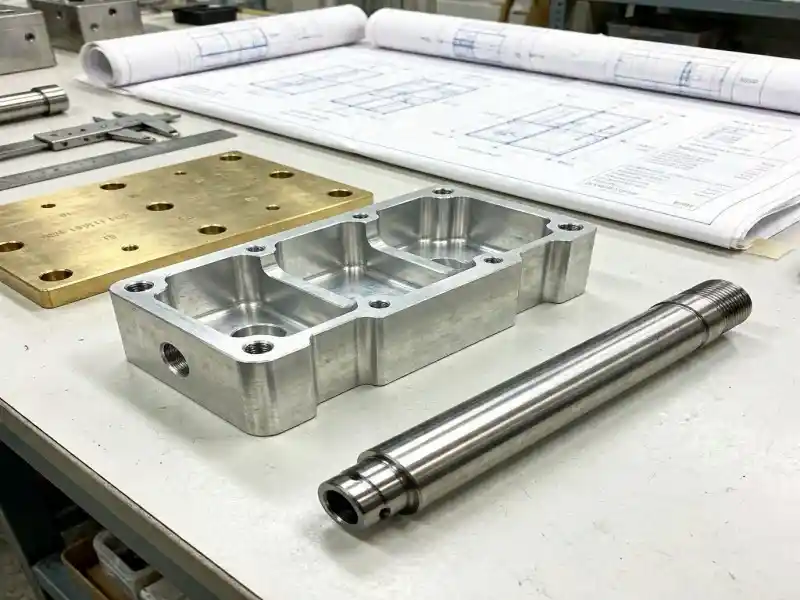
What is the difference between milling and drilling?
Have you ever gotten a quote that was far too high because a simple hole was treated like a complex pocket? That hurts your budget.
Milling cuts sideways with a rotating tool to shape the workpiece surface. Drilling only plunges straight down to create a round hole. Milling is versatile. Drilling is specialized.
I remember a situation at our shop. A buyer sent us a drawing of a bracket. It had six plain holes and one large slot. He asked for a “drilling and slotting” quote. But the slot needed an end mill⁶. The programmer treated the whole job as a milling operation. The quote came back expensive. I saw the drawing and separated the operations. The six holes were standard drilling. The slot was milling. I combined them. The price dropped by 30 percent. This happens because drilling is fast and cheap. A drill bit just goes straight in and out. Milling needs complex toolpaths. The tool moves in many directions. It cuts the shape of the slot or pocket.
Motion and Tooling
A drill bit has two cutting edges and only cuts at the tip. It moves along its own axis. An end mill has cutting edges on the sides and the bottom. It can move sideways. This lets it create slots, pockets, and contoured surfaces.
Chip Evacuation
Drilling pushes chips up the flutes. Deep holes need peck drilling to clear chips. Milling throws chips sideways. Coolant blasts them away. If chip evacuation⁷ is poor, the drill can break. This is a common mistake.
Surface Finish
Drilling leaves a rough inside wall. Reaming usually follows for precise holes. Milling can leave a good surface finish directly. It depends on the toolpath and the stepover.
| Feature | Drilling | Milling |
|---|---|---|
| Tool Movement | Axial only | Multi-directional |
| Typical Tools | Drill bits, reamers | End mills, face mills |
| Operations | Making holes | Facing, slotting, pocketing |
| Cost per feature | Low | Higher |
I always tell buyers to separate holes from other features when they send an RFQ⁸. It helps the shop optimize the process. It saves you money.
How is turning different from milling?
Do you design parts that are mostly round but then add a flat or a slot? Knowing the boundary between turning and milling will change how you design.
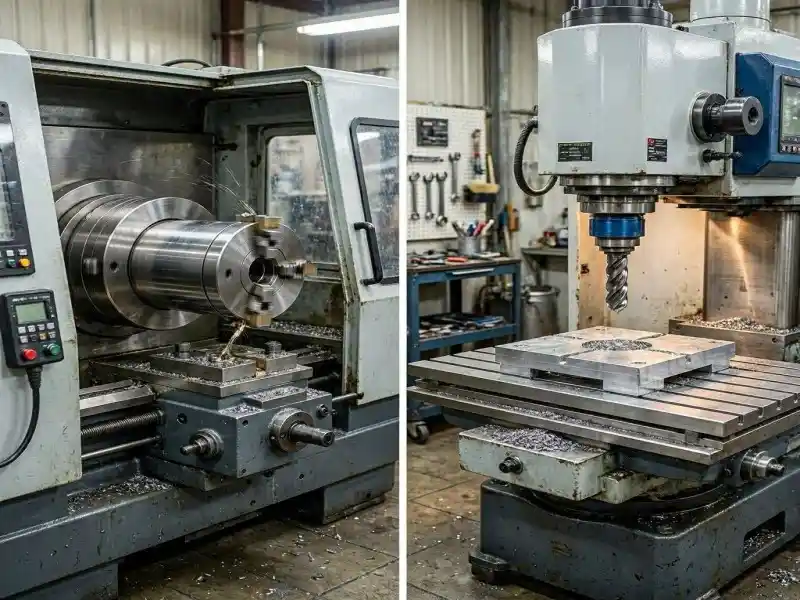
Turning rotates the workpiece against a fixed tool. Milling rotates the tool against a fixed workpiece. Turning makes round parts. Milling makes flat or irregular shapes.
I have a story from our factory floor. A customer gave us a drawing of a roller with a flat keyway⁹. He wanted it fully milled. But milling a cylinder from a block of steel is wasteful. I suggested we turn the roller first. We got the perfect round shape and the shoulder. Then we moved the part to a milling machine. We cut the keyway in one setup. The material waste dropped by 40 percent. The total cycle time was shorter. The customer was happy because the unit price came down.
The Fundamental Difference
In turning, the part moves. In milling, the tool does the complex dance. This changes everything. Turning is great for any feature that is concentric. Think of threads on a shaft. You can cut them in one pass on a lathe. You cannot do that on a mill without a special thread mill.
Accuracy and Setup
Turning naturally holds tight tolerances on diameters. The part rotates. The cutting force is mostly constant. Milling needs more care to hold the same tolerance on a diameter. You might need a boring head¹⁰. Or you must interpolate the circle with an end mill. Both work. But turning is usually more direct.
Surface Finish
A turned surface often looks smoother. The tool leaves a fine spiral mark. A milled surface can have tool step lines. We can polish both. But the starting point is different.
| Aspect | Turning | Milling |
|---|---|---|
| Primary Motion | Workpiece rotation | Tool rotation |
| Typical Parts | Shafts, bushings, pins | Housings, brackets, plates |
| Tolerances | Excellent on diameters | Good on flatness and positions |
| Setup | Fast between centers | Needs clamping and alignment |
I always look at the central axis of a part. If most features are symmetric around that axis, I start with turning. If the part is a box with many faces, I start with milling. This simple rule saves our clients time and money. It also helps us choose the right machine from our 100+ equipment fleet at Ranglink. Our skilled technicians then program the exact sequence.
Conclusion
Turning makes round parts, milling makes complex shapes, and drilling makes holes. Knowing the differences helps you get better quotes and better parts.
Ready to start your next project?
Whether you need high-precision batch production or expert advice on the best machining path, I am here to help.
Contact me today for a fast quote:
Email: info@ranglink.com
WhatsApp: Message us on WhatsApp
- Comprehensive overview of subtractive manufacturing methods.
- Historical and technical guide to lathe machine operations.
- Industry standards for engineering tolerances and limits.
- Technical explanation of reaming tools and surface finishing.
- Guide to thread cutting tools and the tapping process.
- Detailed information on end mill geometries and uses.
- Article on the importance of chip removal in metal cutting.
- Business definition of a Request for Quotation in procurement.
- Mechanical engineering definition of keys and keyways.
- Overview of boring operations for enlarging holes precisely.