
Are you tired of seeing CNC quotes that vary by hundreds of dollars for the same part? High costs and slow feedback from suppliers can delay your entire project schedule.
A CNC machining quote typically includes material costs, machining time (labor and overhead), one-time setup fees (programming and tooling), and finishing costs. To compare them effectively, you must look past the total price and evaluate the breakdown of individual costs, lead times, and quality guarantees.
I have spent over 20 years on the shop floor at Ranglink, and I have seen many engineers get confused by price gaps. It is easy to feel like you are being overcharged when you do not see the logic behind the numbers. I want to share the “insider” view of how we calculate these costs so you can make better decisions for your designs.
How is a CNC machining quote calculated?
Does your quote reflect the actual weight of the part or the size of the raw block? Many designers assume material cost is just the part weight multiplied by the metal price, but that is rarely the case.

CNC quotes are calculated based on material utilization, machine occupancy time, and one-time engineering fees. The “machine time” covers not just cutting, but also setup, tool changes, and part inspection, while one-time fees for programming are spread across the total number of parts ordered.
The biggest factor in material cost is “utilization.” I often see parts where 70% of the raw block becomes scrap¹. If a part has a strange shape, I might only get one piece out of a large plate. At Ranglink, I often help customers tweak part outlines. By moving a line by 2mm, I can fit more parts on one sheet and cut the material cost in half.
Machine time is another area where costs add up. It is not just about the spindle² spinning; it is about how long your part “occupies” my machine. If your design requires three different setups (flipping the part three times), my team has to stop, re-align, and recalibrate each time. These auxiliary tasks can take up 50% of the total time. Furthermore, if you only order one prototype, the programming fee might make up 60% of the bill. When you move to 10 pieces, that fixed cost is shared, and your unit price drops significantly.
| Cost Component | What it Covers | How to Reduce It |
|---|---|---|
| Material | Raw block size + waste | Optimize shapes for better nesting |
| Machining | Cutting + setup + inspection | Reduce the number of setups/flips |
| Setup/Fix | Programming + custom jigs | Increase order quantity to dilute cost |
| Logistics | Shipping + duties + packing | Group orders or choose DDP terms |
Why do CNC machining quotes vary so much between suppliers?

Why does one shop quote $100 while another quotes $150 for the exact same drawing? It feels like guesswork, but the difference usually lies in hidden variables like scrap rates and programming efficiency.
Quotes vary because of differences in scrap rate control, programming sophistication, and profit margins. A cheaper supplier may have a 10% scrap rate that causes delays, while a slightly more expensive supplier provides stable quality, better surface finishes, and more reliable delivery schedules.
Scrap rate is a huge invisible cost. If a shop quotes $100 but ruins one out of every ten parts, their real cost is much higher, and your delivery will be late. I tell my clients that choosing a stable partner is cheaper in the long run than chasing the lowest bid. Quality is a choice that requires investment in better machines and skilled technicians.
Programming skill also creates a 20% price gap. Two programmers can look at the same part; one uses a basic strategy and takes 3 hours, while the other uses high-speed dynamic milling³ to finish in 1.5 hours. The second programmer cuts the machine time in half and provides a better surface finish. Also, be careful with “bargain” quotes. Some shops drop prices to zero profit just to get the job. This is dangerous. If material prices rise or the part is harder than expected, they will quit or ask for more money. At Ranglink, we believe a fair profit allows us to maintain the ISO9001⁴ standards you rely on.
Are you prepared for the “extra” charges that show up after the parts ship? New engineers often miss things like international shipping, customs duties, or specialized packaging that can ruin a budget.
Common hidden costs include shipping (FOB vs. DDP), specialized protective packaging, and fees for inspection reports or material certifications. Additionally, “small” design changes after a quote is issued often trigger expensive re-programming and setup fees that weren’t in the original estimate.
Logistics is a major trap for beginners. Many suppliers quote “FOB,” which means you are responsible for everything once the parts leave the factory. I have seen customers shocked by port fees and customs duties⁵. I always suggest asking for a “DDP⁶” (Delivered Duty Paid) quote so you know the final price to your door. Packaging is another hidden factor. Precision parts are useless if they arrive scratched. We use custom foam and anti-rust bags at Ranglink because saving $2 on a box is not worth ruining a $500 part.
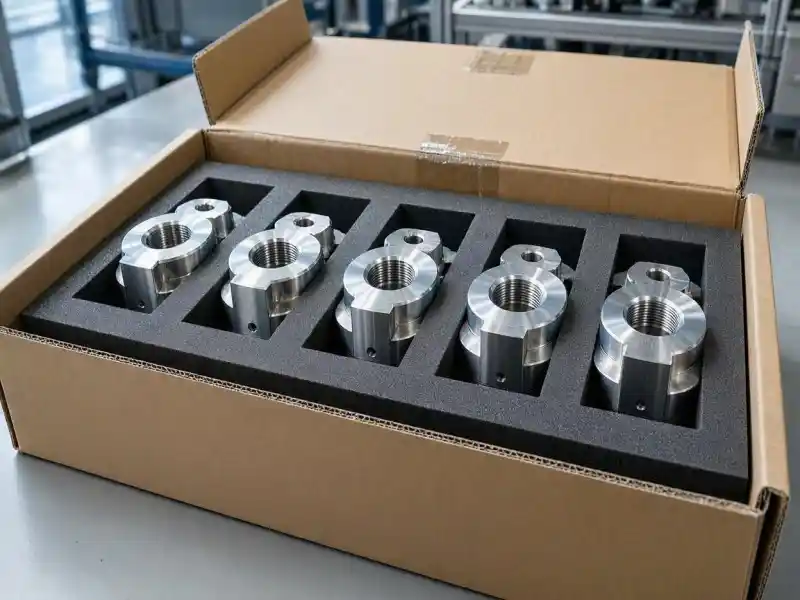
Always check if the inspection report is included. Some shops charge extra for this, or worse, they don’t have the equipment to do it and just “guess” the numbers. You should demand a full dimensional report and material certs in the initial inquiry. Finally, remember that “one small change” to a hole diameter isn’t free. It usually means I have to redo the programming and the setup. A good supplier will be honest about these costs upfront.
| Hidden Cost | Impact | Prevention |
|---|---|---|
| Shipping Terms | Adds 10-30% to total | Ask for DDP (Delivered Duty Paid) |
| Packaging | Surface damage risk | Specify “no-contact” or foam packing |
| Certifications | Quality disputes | Request material & inspection reports |
| Re-programming | Sudden bill increases | Finalize design before quoting |
How do you compare CNC quotes like a pro?
How do you know which supplier is the best fit for your project? Comparing total prices is a rookie mistake; you need to look at the “net unit price” and the commitment to quality.
Professional comparison involves looking at itemized breakdowns, comparing the “repeat order” price without setup fees, and evaluating the supplier’s scrap rate and on-time delivery history. A small batch “test order” is the ultimate way to verify if a quote is honest.
I always recommend asking for an itemized quote. If a supplier only gives you a single total number, they are likely hiding something or are too lazy to do the math. When I provide a quote for Ranglink, I break down the material, machining, and finishing. This helps you see where your money is going. Also, look at the price for the second order. The first order includes “non-recurring engineering⁷” (NRE) costs like programming. If you plan to buy 1,000 parts eventually, the price for the 1,000th part is more important than the price for the first prototype.
Another pro tip is to ask about their scrap rate. If they cannot give you a number, they aren’t tracking their quality. If they say “under 1%,” that is a good sign. You should also treat lead time⁸ as a hard metric. A supplier who is 5% cheaper but 2 weeks late costs you more in lost time. Use a small test order to compare three suppliers. See who communicates best, who provides the most detailed report, and whose parts actually fit. That data is worth more than any number on a spreadsheet.
Conclusion
Understanding CNC quotes requires looking at material utilization, programming efficiency, and hidden logistics. Compare itemized costs and lead times to find a partner that balances precision with long-term value.
Ready to start your next project?
Whether you need high-precision batch production or expert advice on the best machining path, I am here to help.
Contact me today for a fast quote:
Email: info@ranglink.com
WhatsApp: Message us on WhatsApp
- Definition of scrap and waste in manufacturing processes.
- Explanation of spindles as rotating axes in machine tools.
- Overview of high-speed machining and dynamic milling strategies.
- Information on ISO 9000 series and ISO 9001 quality management standards.
- Explanation of customs duties and international trade tariffs.
- Overview of Delivered Duty Paid (DDP) Incoterms in logistics.
- Explanation of Non-Recurring Engineering (NRE) costs in manufacturing.
- Definition of lead time in supply chain and production management.