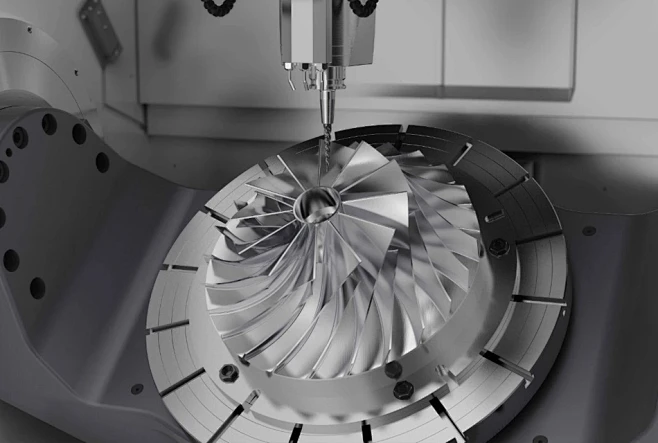
5-axis machining technology is a key piece of equipment in industries where precision machining is a major demand, enabling the production of high-end CNC machine tools and molds. The quality of mold products is largely influenced by CNC equipment. In a highly competitive market, the manufacturing industry faces the challenge of seeking shorter production cycles, higher processing quality, faster product modification capabilities, and lower manufacturing costs. Therefore, 5-axis machining technology has gained significant attention. This article will delve into the principles and applications of 5-axis machining technology, helping you understand how to implement it and create transformation opportunities for your business.
What is 5-axis machining? Understanding its operating principles and advantages!
5-axis machining is an advanced CNC machine tool processing technology that simultaneously controls the movement of a workpiece on three linear axes (X, Y, and Z) and two rotary axes (A and B). This technology offers high flexibility and precision, enabling the production of complex parts with stringent precision requirements.
Operating Principle During metal cutting, the immense cutting and frictional forces cause the workpiece to move, thus requiring an axis to hold it in place. Common three-axis machine tools only have three linear degrees of freedom, capable of handling structures along the tool axis but unable to handle lateral features. Five-axis machining utilizes at least five coordinate axes (X, Y, Z, A, B – three linear and two rotary axes) under the coordinated control of a computer numerical control (CNC) system, allowing each axis to have an independent controller and motor drive system for synchronized motion.
Are there true and false five-axis machining methods?
Sometimes, what you perceive as five-axis machining isn’t truly five-axis! True five-axis machining technology must possess RTCP (Rotational Tool Center Point) functionality; meaning that during synchronized five-axis motion, the machine tool can maintain the cutting point (tool center point) of the tool unchanged, even if the tool itself is rotating or tilting. How can you tell? The simplest way is to observe whether the axes move simultaneously! True 5-axis machining means five axes with five-axis linkage, while pseudo-5-axis machining may only have three axes with the other two axes serving only a positioning function.
Advantages of 5-axis Machining:
- Capability to machine complex geometries: 5-axis machining technology can complete multi-faceted machining in a single setup, avoiding errors caused by multiple fixture changes.
- Increased production efficiency: 5-axis machining reduces downtime and fixture changeover time, thus increasing production efficiency.
- Shorter production cycle: 5-axis machining shortens the overall production cycle by reducing setup time.
- Improved machining accuracy: Due to reduced machining errors, 5-axis machining technology also improves machining accuracy.
- Extended tool life: In 5-axis machining, the contact area between the tool and the workpiece is smaller, which helps reduce tool wear and extend tool life.
Is 5-axis machining good? A comparison with 3-axis and 4-axis machining!
5-axis machining includes three linear feed axes (X, Y, Z) and two rotary axes (A, B), enabling complex synchronous movements. This technology allows for precision machining of complex shapes and improves production efficiency. Four-axis machining involves three linear feed axes (X, Y, Z) and one rotary axis, enabling continuous or segmented rotation. This technology offers significant advantages for machining cyclically symmetrical or elongated workpieces, improving efficiency and accuracy.
Three-axis machining primarily involves the movement of three linear feed axes: X, Y, and Z. This technology is particularly effective for machining planar or three-dimensional geometric surfaces, achieving simple, fast, and high-precision machining.
Five-axis Machining Considerations! Master These 4 Things to Improve Product Accuracy!
R&D Personnel Need to Communicate More with Data Experts Five-axis machining is computer-controlled (CNC), so data is a key factor affecting machining and determining product accuracy. Therefore, the R&D team needs to work closely with data experts, carefully adjusting parameters from the initial stages. Through cross-disciplinary communication and collaboration, we can ensure the accuracy of product manufacturing.
High-Performance Drive System In five-axis machining, an excellent drive system plays a crucial role. It not only provides excellent dynamic characteristics but also has a wide speed range. This drive system effectively reduces workpiece errors, ensuring machining quality while allowing for greater precision.
Tool Adjustment Before Operation: Tool adjustment is a crucial aspect of 5-axis machining. Tool collisions are inevitable during processing, but given the extremely high precision required in 5-axis machining, even minute deviations can have significant impacts. Therefore, we insist on rigorous tool calibration before each use to ensure accuracy and guarantee the highest product quality.
Choosing the Right Partner: Selecting the right service provider is another key factor in improving 5-axis machining efficiency. An excellent service provider will not only communicate effectively and understand your needs, but also implement your machining goals and provide ongoing support and follow-up services, continuously adjusting the product to enhance the user experience.
Conclusion:
After reading the above, you should understand that the data-driven and high-precision advantages of 5-axis machining technology can significantly improve product performance and quality, indirectly bringing strong brand value to your company. If you are interested in implementing 5-axis machining technology in your company, please contact us!
📩 Email: rang@ranglink.com
📱 WhatsApp: +86 17338532394
🌐 Request a quote: www.ranglink.com