
You need custom metal parts. You compare CNC turning and CNC milling services. Choosing feels confusing. Let’s simplify this decision.
CNC turning excels for cylindrical parts like shafts via rotational cutting. CNC milling suits complex 3D shapes like brackets using multi-directional tools. Neither is universally “better”—the optimal choice depends on your part’s geometry, material, and volume.
Continue reading to match your project to the right process.
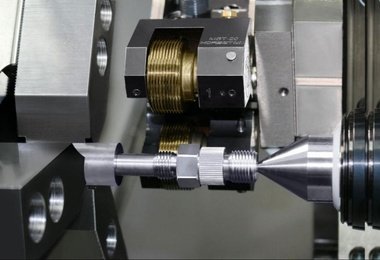
What Are The Main Differences Between CNC Turning And CNC Milling?
You review machining options. Turning and milling sound similar. But their approaches differ fundamentally.
Turning rotates the workpiece against a fixed tool, creating radial symmetry. Milling moves a rotating tool across a stationary workpiece, enabling complex contours. Turning produces faster for simple geometries; milling achieves intricate features.
Core Mechanics and Application Scenarios
The distinction starts with movement. In turning, the material spins while tools trim it. This efficiently shapes rods or tubes into pins or bushings. Milling reverses this: tools rotate and traverse while the material stays fixed. This carves pockets, slots, or angled surfaces into blocks.
| Aspect | CNC Turning | CNC Milling |
|---|---|---|
| Work Setup | Rotating workpiece | Stationary workpiece |
| Tool Action | Stationary tools | Moving, rotating tools |
| Ideal Parts | Bushings, shafts, discs | Housings, molds, frames |
| Complexity | Moderate (axisymmetric) | High (multi-plane features) |
Turning dominates for conical or circular profiles. Milling tackles prismatic designs needing diverse operations. Many projects combine both—e.g., a gear might be turned then milled for keyways. Share your CAD files with suppliers. They’ll recommend the most efficient method.
Which Manufacturing Service Is Better For Custom Metal Parts: CNC Turning Or CNC Milling?
You seek cost-effective custom parts. Should you prioritize turning or milling? The answer hinges on your design.
For purely rotational components (e.g., flanges), turning delivers lower costs and faster cycles. For parts requiring pockets, threads, or asymmetrical elements, milling is unavoidable. Most functional prototypes use milling for flexibility.
Geometry-Driven Process Selection
Examine your part’s blueprint. Axisymmetric designs thrive on lathes. Turning minimizes material waste and cycle time. However, off-center holes or flat faces demand milling. Volume matters too. High batches justify dedicated turning lines. Low-volume prototypes often use milling centers for adaptability.
Material behavior also guides choices. Aluminum machines smoothly with both. Hardened steel benefits from milling’s rigidity control. Always request DFM feedback. Suppliers like Ranglink optimize designs to blend processes—turning main bodies while milling side features. This reduces your total cost.
Will AI Replace CNC Machining?
You hear about AI transforming manufacturing. You wonder if human-operated CNC machining will become obsolete. The reality is more nuanced.
AI enhances CNC machining but won’t replace it. Machine learning optimizes tool paths and predicts maintenance needs, while skilled technicians remain essential for setup, quality control, and complex decision-making. The future lies in human-AI collaboration[1].
Augmenting Precision, Not Eliminating Expertise
AI currently serves three key roles in machining:
- Process Optimization: Algorithms analyze sensor data to reduce vibration and tool wear.
- Predictive Maintenance: AI flags machine issues before failures occur.
- Quality Monitoring: Vision systems detect surface defects in real-time.
| Capability | AI Contribution | Human Role |
|---|---|---|
| Tool Path Planning | Generates efficient routes | Validates feasibility |
| Error Detection | Flags anomalies in real-time | Diagnoses root causes |
| Setup | Suggests parameter templates | Executes fine adjustments |
At Ranglink, we use AI for predictive maintenance[2] and tool life management. This reduces downtime by 30%. But our technicians still oversee all critical operations. Complex geometries and custom materials require human judgment. AI handles routine tasks, freeing experts for high-value work. The synergy improves both precision and efficiency.
Conclusion
Select turning for rotational parts and milling for complex designs. Embrace AI as a tool to enhance—not replace—skilled machining.
Are you looking for precision CNC solutions? Choose Ranglink as your partner in China.
We guarantee:
- Quotation response within 24 hours
- Extensive experience in small-batch production
- Full material certification available
Please visit www.ranglink.com and submit your CAD files to receive a free manufacturing analysis.
[1]: Discover the role of human-AI collaboration in CNC machining and how it enhances precision and efficiency.
[2]: Explore how predictive maintenance can enhance CNC machining efficiency and reduce downtime.