
Are you struggling with parts that do not fit? Poor precision ruins your assembly and costs you a lot of money. I understand your frustration and I can help you today.
To select high-precision parts, you must verify the supplier’s machine tolerances, inspection tools, and material certifications. Focus on shops that offer micron-level accuracy and use advanced CNC centers to ensure every dimension meets your specific engineering requirements consistently across every batch and every single order you place.
Choosing the wrong supplier leads to big delays and wasted budgets. I have seen many buyers make this mistake because they do not know what to look for. You need to stay focused on the details to avoid these common traps. If you want to get the best results, you must look deeper into the technical side of the process.
What is high precision CNC machining?
Tight tolerances can be a nightmare to manage if you do not have the right partner. One wrong move and the whole batch of parts becomes expensive scrap metal. I know you need parts that work perfectly without any extra manual adjustments or rework.
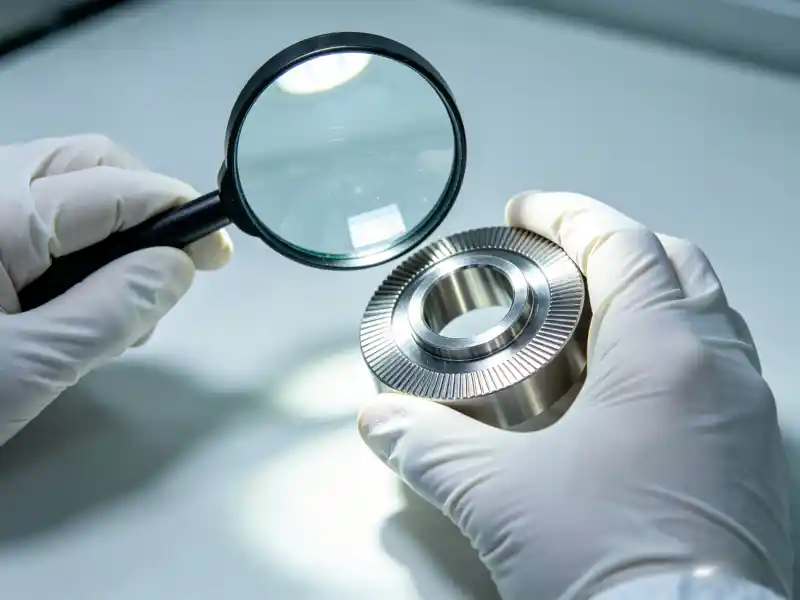
High precision CNC machining is a process that creates parts with extremely tight tolerances, often within +/- 0.005mm. It uses computer-controlled tools to cut away material from a workpiece, ensuring complex shapes are made with incredible repeatable accuracy and very smooth surface finishes for every single piece produced.
At Ranglink, we know that high precision is not just about having fast machines. It is about total control over the environment and the tools. We have over 20 years of experience in manufacturing automated equipment parts. Our facility covers 3,000 square meters and holds over 100 advanced machine tools. We use lathes, milling machines, and boring machines to hit numbers that human hands simply cannot reach.
I once worked on a project for a client who needed a very small gear. If the part was off by just 0.01mm, the entire automated line would crash. We used our high-end CNC machining centers to ensure every tooth was perfect. Precision means your assembly line stays moving and your customers stay happy. We follow ISO9001 standards to make sure our work is consistent. This is why our technicians spend so much time on setup and tool calibration. We do not just cut metal; we follow a strict process to ensure the final part matches your drawing exactly.
| Feature | Standard Machining | High Precision Machining |
|---|---|---|
| Tolerance Range | +/- 0.1mm to 0.5mm | +/- 0.005mm to 0.01mm |
| Surface Finish | Rougher (Ra 3.2 or more) | Very Smooth (Ra 0.8 or less) |
| Machine Type | Basic Lathes/Mills | 5-Axis CNC / Grinding Machines |
| Best Use | Simple Brackets | Aerospace / Medical / Robotics |
How to know if it’s high accuracy and high precision?
Do your parts look good but fail when you try to use them in the field? This gap between your expectation and the actual reality hurts your company reputation. I can show you how to tell the difference between these two terms right now.
Accuracy means hitting the target value exactly, while precision means hitting the same spot repeatedly. High-quality parts must have both. You check this by looking at Cpk data and inspection reports that show consistent measurements across multiple production runs and different batches of parts from your supplier.
I see many buyers get confused by these terms. Accuracy is about being “right” according to the blueprint. Precision is about being “consistent” over hundreds of parts. At Ranglink, we aim for both. If a factory makes one perfect part but the next ninety-nine are all different, that is a big problem for your assembly line. We use our 60 highly skilled technicians to monitor every step.
We look at the “spread” of the measurements. If all the parts fall within a very tiny range, we know our machines are dialed in. I always tell my team that a “precise” mistake is still a mistake. For example, if we make every part exactly 0.02mm too large, we are precise but not accurate. We use high-end boring and grinding machines to ensure we stay right in the center of your tolerance zone. This helps you avoid the “stack-up” errors that happen when many parts are slightly off.
| Term | What it means | Example in CNC |
|---|---|---|
| Accuracy | Nearness to the true value | Hitting 10.00mm on a 10.00mm spec |
| Precision | Repeatability of the measurement | Making 100 parts that are all 10.01mm |
| High Both | The gold standard | Making 100 parts that are all 10.00mm |
What are the 4 principles of accurate measurement?
Measurement errors lead to expensive assembly failures that no one wants to deal with. If your supplier uses bad tools or wrong methods, you are the one who pays the price. I want to help you spot these measuring mistakes before they ruin your project.
The four principles include the Abbe Principle, the Principle of Minimum Error, the Principle of Alignment, and the Principle of Constant Temperature. These rules ensure that measuring tools are used correctly to get the most truthful data about a part’s actual physical dimensions during the final inspection process.
Measurement is a real science. You cannot just pick up a basic caliper and hope for the best when tolerances are tight. At our factory, we follow these four rules strictly. First, the Abbe Principle tells us that the measuring scale must stay in line with the dimension being measured. If it is at an angle, the reading is wrong. Second, we look for the “Minimum Error” by choosing the right tool for the job. You do not use a ruler to measure a micron.
Third, alignment is key. We ensure the part is sitting flat and true on our granite plates. Fourth, and very importantly, we control the temperature. Metal expands when it gets hot and shrinks when it gets cold. If we measure a part while it is still hot from the machine, the number will be wrong. We let parts cool down in our climate-controlled inspection room. This is how we maintain our ISO9001 certification and keep our quality high for every US buyer we serve.
| Principle | Main Focus | Why it matters |
|---|---|---|
| Abbe Principle | Tool Alignment | Prevents parallax and offset errors |
| Minimum Error | Tool Selection | Ensures the tool is fit for the tolerance |
| Alignment | Part Positioning | Prevents “tilted” or false readings |
| Temperature | Environment | Metal size changes with heat |
What is the 10 rule for gauge tolerance?
Are your inspection results different from the results your supplier sends you? This creates massive arguments and delays that waste your time. I use a very simple rule to stop these conflicts from ever starting in my factory and I think you should too.
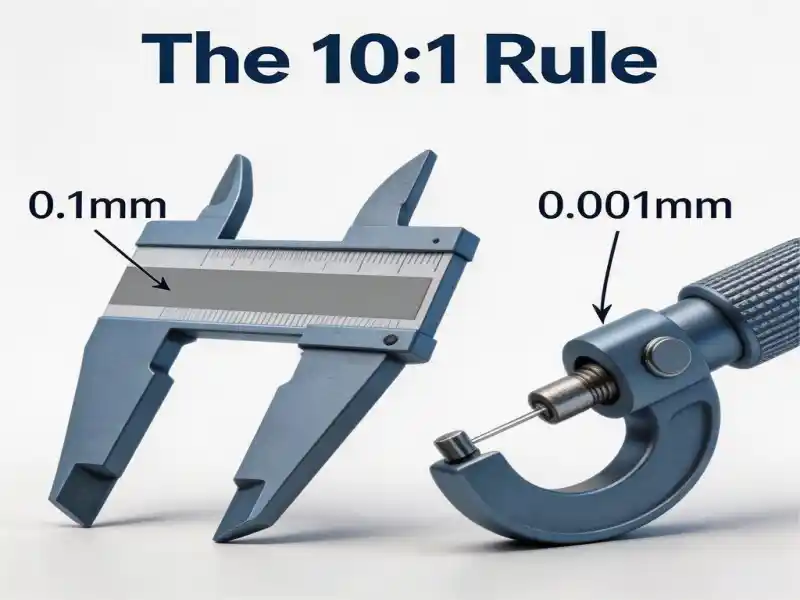
The 10 rule, or the Rule of Ten, states that a measuring instrument should be ten times more precise than the tolerance it is checking. For example, if your part tolerance is +/- 0.1mm, your gauge must be able to measure accurately down to 0.01mm to be valid.
This rule is often called the “Gage Maker’s Rule.” It is a safety margin for measurement. If your tool is only as precise as your part, you will have too much “noise” in your data. You might reject a perfectly good part or, even worse, accept a bad one. At Ranglink, we take this seriously. When a customer like Alex sends us a print with a 0.02mm tolerance, we do not use a standard digital caliper. We use a high-precision micrometer or a CMM that can see down to 0.002mm.
We invest heavily in our tools because we know your reputation is on the line. Our facility has over 100 machines including specialized tapping and grinding tools. We check our gauges every day to make sure they are calibrated. If the gauge is not ten times better than the part, we do not use it. This simple rule eliminates 90% of the quality disputes between buyers and sellers. It gives you the peace of mind that the report we send you is 100% true and accurate.
| Part Tolerance | Required Gauge Resolution | Tool Example |
|---|---|---|
| +/- 0.1 mm | 0.01 mm | Digital Caliper |
| +/- 0.01 mm | 0.001 mm | Digital Micrometer |
| +/- 0.005 mm | 0.0005 mm | High-end CMM / Laser |
Conclusion
Choosing high-precision parts requires understanding tolerances, measurement principles, and the Rule of Ten. Partnering with an experienced manufacturer like Ranglink ensures your parts meet these strict standards every time.
Ready to turn your idea into reality?
Upload your CAD file for a free quote within 24 hours. 👉Email: rang@ranglink.com